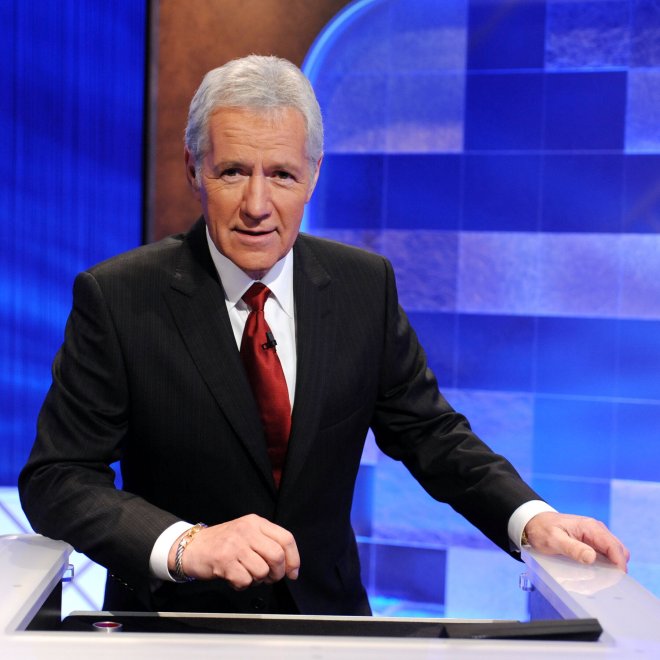
Photo courtesy of Amanda Edwards/ Getty Images
Alex Trebek stared into the camera to tell the world he had stage 4 pancreatic cancer. No one was entitled to know about his diagnosis, but he gifted the public with this information anyway.
That’s how much Trebek valued truth — enough to make himself vulnerable.
His face didn’t fall as he made the announcement in March 2019, and his eyes didn’t swell with tears. Instead, Trebek was matter-of-fact, as usual. He had accepted this reality, but still maintained faith.
The late “Jeopardy!” host believed, with prayers and support, that he would be among the 9% of people who survived the disease.
He wouldn’t hold on just for friends and family, but also for the fans at home.Trebek had to finish the job he’d held longer than the time he was married to his second wife, Jean, and longer than he’d been a U.S. citizen. The couple wed in 1990, and the Canadian was naturalized in 1998.
“Truth told, I have to!” Trebek said in his announcement. “Because under the terms of my contract, I have to host ‘Jeopardy!’ for three more years!”
Trebek always knew how to keep things light. He had 37 seasons of practice as the “Jeopardy!” host to perfect this skill.
Seth Wilson, a 12-time “Jeopardy!” champion and 2017 Tournament of Champions quarterfinalist, told Vulture after Trebek’s death on Nov. 8 that the host made contestants feel special even if the answers to their questions were incorrect. Being told, “Ooh sorry” wasn’t so bad coming from Trebek.
Even as the cancer metastasized in the 80-year-old’s body, Trebek continued to make contestants feel comfortable. “Jeopardy!” was better because of it.
Trebek genuinely cared about others and their lives. The father of three wanted to know his contestants in a real way, but he was also unafraid to tell even the brightest of them that they were, in fact, wrong.
It’s who Trebek was, and that’s why his death hit generations of Americans so hard.
He empowered the bookish and geeky to be themselves, validating their guesses at the television screen with an assured, “That’s correct.”
When John Mayer was a kid, he’d watch his father, an educator, answer Trebek’s “Jeopardy!” questions like “a cowboy plinking cans off a fence.”
“It was because of this duo of Alex Trebek and my dad — the host setting up cans and the old man sending them flying end-over-end before the three contestants could reach their holsters — that I came to respect intelligence as a deeply valuable thing to seek and possess,” the singer-songwriter wrote in a tribute to Trebek on his Instagram page.
He would have never said so, but Trebek was the reason for the success of “Jeopardy!”. His loyalty and humility embodied an era that wasn’t ruled by the nihilism of today. While Trebek’s death added to the mounting list of tragedies in 2020, he probably wouldn’t see it that way.
The host would be the first to say he lived a good life. He was optimistic and selfless, a counter to society’s general dread. In the “Jeopardy!” studio on Oct. 29, 10 days before he died, Trebek was also determined. Even as his face sank, his hair fell out and his shuffles slowed, Trebek refused to quit and continued to educate.
He could teach us all something about enjoying life amid discomfort, rather than wallowing in it.
Maybe Trebek continued to host “Jeopardy!” to prove something to himself, to not feel like he was dying. Or it was an act of public service. The icon would still be there behind the podium if fate would have it.
Trebek knew his love for “Jeopardy!” fans was mutual. He wasn’t just a host, but to contestants and viewers, he was their host.
“What is we love you, Alex?” Dhruv Guar, a contestant, wrote last November for his final jeopardy.
Guar’s answer to the question about an 1890 expose was incorrect, but Trebek made him feel good anyway.
 myah taylor